


Trends in LED Lighting Technology: From Efficient Light Source to Intelligent Lighting
By hqt
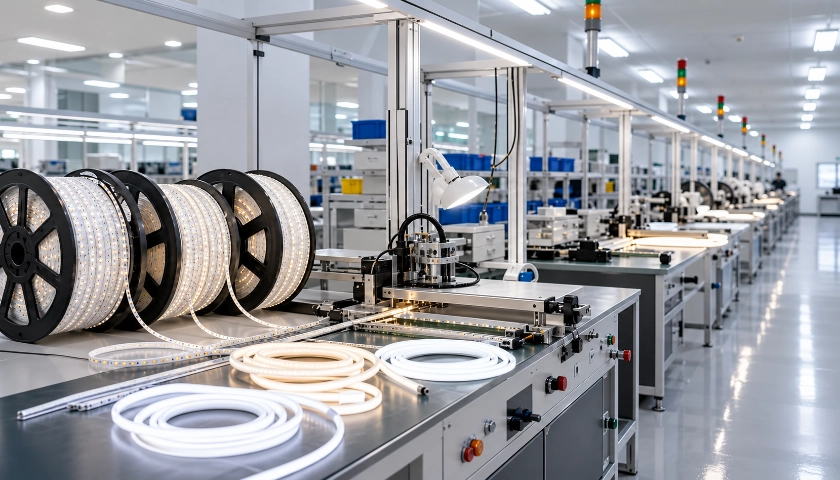
LED lighting has become an important technological direction in the modern lighting industry. From ceiling lights and downlights in homes to linear lights and track lights in commercial buildings, and further to road, landscape, and industrial lighting, LED technology is changing the way people use light.
In the past, lighting technology development mainly revolved around brightness and energy efficiency. Today, with continuous advances in semiconductor technology, optical design, and digital control, LED lighting is moving toward higher luminous efficacy, better light quality, more flexible control, and more sustainable product design.
Why Can LED Technology Change the Lighting Industry?
LED stands for Light Emitting Diode and is a semiconductor light source.
Unlike traditional incandescent lamps, which emit light by heating a filament, LEDs produce light through the recombination of electrons and holes in semiconductor materials.
This light-emitting method has relatively high energy utilization efficiency and also brings more possibilities to luminaire design.
The main advantages of LED technology include:
- Higher energy efficiency: It can usually reduce electricity consumption while meeting the same lighting needs.
- Longer service life: Reasonable thermal and driver design helps extend the product's effective operating time.
- Flexible optical design: Light distribution can be controlled through lenses, reflectors, and diffusing materials.
- Rich light color options: It supports different color temperatures, colored lighting, and some tunable-spectrum applications.
- Digital control capability: It can be combined with sensors, dimming systems, and building management platforms.
These characteristics make LED no longer just a replacement for traditional bulbs, but an important part of modern lighting systems.
Higher Luminous Efficacy Remains an Important Direction
Luminous efficacy is an important metric for measuring the energy utilization efficiency of a light source, expressed in lumens per watt (lm/W).For example, all else being equal, a luminaire with an efficacy of 150 lm/W can output more luminous flux from the same electrical energy than one with 100 lm/W.
However, higher luminous efficacy does not necessarily mean a better lighting experience.In practical applications, color rendering, color temperature, glare control, and the luminaire's effective light distribution also need to be considered.
Especially in offices, commercial spaces, and public buildings, lighting design must satisfy both energy efficiency and visual comfort.Therefore, the future focus of LED technology is not only improving luminous efficiency, but also enhancing effective lighting quality.
From Single Lighting to Intelligent Lighting
Traditional lighting systems usually control luminaires through switches, while intelligent LED lighting can automatically adjust brightness and operating status according to the actual environment.For example:
- Offices use daylight sensors to adjust artificial lighting brightness.
- Corridors and parking lots use occupancy sensing to reduce lighting energy consumption when unoccupied.
- Hotels use scene control to switch between different lighting atmospheres.
- Building facades use digital control to achieve dynamic lighting effects.
These functions allow lighting systems to adapt more flexibly to buildings and user needs.With the development of wireless communication technology and smart building platforms, lighting equipment is also becoming part of building digital management systems.
Light Quality Is Receiving More Attention
In the past, consumers often first focused on power and brightness when buying luminaires.Now, factors such as color rendering index, color temperature, glare, flicker, and light uniformity are receiving increasing attention in the lighting industry.
For example, high-color-rendering lighting helps present the colors of merchandise, food, and interior materials more naturally; reasonable anti-glare design can reduce the interference of strong light sources with vision; and good driver design helps control unnecessary fluctuations in light output.For environments such as education, offices, healthcare, and retail, light quality has become an important evaluation dimension in lighting design.
LED Luminaires Are Moving Toward Modular and Maintainable Design
As the service life of LED light sources extends, the reliability of other luminaire components becomes more important.Drivers, thermal structures, sealing materials, and connecting components can all affect the service life of the entire luminaire.
Modular design allows some luminaires to replace only the components that need maintenance when a driver or light source module fails, rather than replacing the entire luminaire.
This design helps reduce maintenance costs and electronic waste while improving the long-term value of the luminaire.Of course, modular design also needs to consider standardization, product compatibility, and electrical safety.
Conclusion
The development of LED lighting technology has gradually expanded from simply pursuing energy savings to multiple directions such as light quality, intelligent control, product reliability, and sustainability.In the future, LED luminaires will not only provide the basic function of brightness, but will also participate more deeply in spatial design, energy management, and building digital systems.
For the lighting industry, the ultimate value of technological progress is to provide higher-quality, more flexible lighting experiences with more reasonable energy consumption.

